 010941d202 * fix(standalone): pin @lydell/node-pty-linux-arm64 and make missing prebuilds fatal at release The wrapper publishes a linux-arm64 prebuild at the same 1.2.0-beta.10 pin, but the root and core manifests never declared it, so the linux-arm64 standalone archive and the linux-arm64 Desktop runtime both degraded to "PTY not available" while every other target shipped a working web terminal. With the pin in place every shipped target resolves a prebuild package, so the release archive build can stop degrading silently: release.yml now exports QWEN_STANDALONE_REQUIRE_NODE_PTY_PREBUILD=1 next to the existing audio-capture gate, turning a missing prebuild into a hard failure instead of another #11872. Fixes #11872 * fix(standalone): update pnpm lockfile for the linux-arm64 node-pty pin The two package.json manifests gained @lydell/node-pty-linux-arm64 but pnpm-lock.yaml was not regenerated, so every CI job failed at the frozen-lockfile install with ERR_PNPM_OUTDATED_LOCKFILE. * docs(standalone): align the linux-arm64 PTY guide and tripwire with the pin Pinning @lydell/node-pty-linux-arm64 makes linux-arm64 a supported PTY target, but INSTALLATION_GUIDE.md still told users that archive ships without PTY and reports "PTY not available". CI could not catch the drift because install-script.test.js pinned that exact sentence as its tripwire, so the guide and the assertion have to move together. List all five shipped targets in the guide, retarget the tripwire at the new sentence, and refresh the matching stale comment in desktop-shell's test-release.js degrade fixture - that arm now only fires for a target the map does not know. Co-authored-by: Qwen-Coder <qwen-coder@alibabacloud.com> * fix(standalone): complete the node-pty linux-arm64 pin in esbuild externals `create-standalone-package.js` documents that "esbuild.config.js keeps every node-pty specifier external" so the bundled CLI resolves the platform prebuild from `lib/node_modules` at runtime. The external list carried five of the six pinned platform packages and omitted `@lydell/node-pty-linux-arm64` — the exact platform this PR pins. Nothing imports that specifier statically today, so the bundle is unaffected; the gap is that the invariant the archive's PTY support rests on was one entry short of complete. Probe (esbuild, `--platform=node --format=esm`, entry importing both specifiers): - without the entry: `Could not resolve "@lydell/node-pty-linux-arm64"` - with the entry: builds clean and emits the import left external, matching the other five platforms Also corrects two comments this PR rewrote in the previous round. Both claimed the desktop degrade arm "fires only for a target the map does not know (a future platform)". That trigger is unreachable: `desktopTarget()` throws `Unsupported desktop target` for anything outside its five-entry allowlist and `NODE_PTY_PREBUILD_PACKAGE` maps exactly those five, so `prebuildPackage` is always a real name. Verified by running the script: $ QWEN_DESKTOP_SKIP_BUILD=1 QWEN_DESKTOP_TARGET=freebsd-x64 \ node packages/desktop-shell/scripts/prepare-runtime.js Error: Unsupported desktop target: freebsd-x64 at desktopTarget (prepare-runtime.js:351:11) The reachable trigger is the one the warn string already names and the one `test-release.js` reproduces four lines below its own comment: a known target whose prebuild package is unpinned in the source root manifest. Comment-only apart from the single external entry. prettier --check and eslint --max-warnings 0 clean on all three files; node --check passes. Co-authored-by: Qwen-Coder <qwen-coder@alibabacloud.com> * test(standalone): pin the node-pty release gate and its target map Closes out three review findings on the node-pty pin. Test- and comment-only apart from one new export; no production behavior changes. R1-1 prepare-runtime.js: the nodePtyPackageSpecs() docstring still claimed its null return "is how an unsupported target degrades". desktopTarget() throws for anything outside its five-entry allowlist, and test-release.js:testRuntimeNodePtyTargetMapping() asserts NODE_PTY_PREBUILD_PACKAGE's keys equal exactly that allowlist, so an unknown target can never reach it. A null here is a dropped pin. Verified by re-running that tripwire's extraction against the edited file: both literals still match and keys == allowlist == the same five targets. R1-2 create-standalone-package.js: export TARGET_PREBUILD_DIR and assert every release target maps to a package the manifests actually pin. The guide sentence this PR adds states that invariant while release.yml:707 makes violating it abort the whole archive step, yet the map had zero test references. The expectation is derived from readNodePtyPackageSpecs() so the version list stays single-sourced, and is one-directional because @lydell/node-pty-win32-arm64 is pinned while no target maps to it. R1-3 install-script.test.js: the release.yml assertion matched only the variable name, which also appears in the packager's usage text, so nothing connected producer to consumer and no test executed the fail() branch at create-standalone-package.js:578. Tightened to the full wiring line and added the behavioral twin of the audio-capture pair: gate on with the addon removed must throw, gate off must still build a PTY-less archive. packageFakeStandalone() gained an env option for this; spreading process.env leaves its 15 existing callers unchanged. Mutation-checked, each mutant applied alone then restored and md5 verified: win-x64 mapped to an unpinned name, gate reader renamed to '2', gate polarity flipped to !==, and release.yml no longer evaluating to '1' are each caught by a new or tightened assertion. The polarity flip was previously undetectable on the PR lane, where the linux-x64 prebuild is present so the gate is never reached. Focused: install-script.test.js 130 passed / 11 skipped (141). prettier --check and eslint --max-warnings 0 clean on all three files. Co-authored-by: Qwen-Coder <qwen-coder@alibabacloud.com> Patrol-Run: qwen-pr-closeout/jmufv3et42h * docs(standalone): state the real node-pty degrade conditions in comments prepare-runtime.js said the degrade arm fires only "where the repo pins nothing", but nodePtyPackageSpecs returns null at the first unpinned name of the pair, so it also fires when the wrapper pin is the one that went missing while the warning names the prebuild package. Say "either name in the pair" and note which package the warning names. create-standalone-package.js justified the non-fatal default with "a developer archive stays usable on an unmapped future target", which cannot happen: main() calls copyNativeAddon first and it reads the same TARGET_PREBUILD_DIR in an unconditional path.join(), so an unmapped target dies with a TypeError in the audio step before copyNodePtyAddon runs. Replace the rationale with the case that does reach the warn arm (a target whose prebuild the host install does not have). Comment-only; no behaviour change. Co-authored-by: Qwen-Coder <qwen-coder@alibabacloud.com> Patrol-Run: qwen-pr-closeout/jmug1iw422v * test(standalone): make the node-pty gate assertions discriminate Pin the `Required ` prefix on the fatal-gate regex. copyNodePtyAddon builds one message and emits it on both paths, so the prefix-less regex was also satisfied by the degrade warning folded into the child's stderr — the suite would have reported the gate as covered after the prefix was dropped from fail(). The sibling clipboard gate assertion already spells the prefix. Assert QWEN_STANDALONE_REQUIRE_NODE_PTY_PREBUILD structurally on the `Build Standalone Archives` step env instead of as a whole-file substring, so commenting the line out or moving it into a neighbouring step's env goes red. build-standalone-release.js spawns the packager with no env override, so that step's env is the only route to the gate. The comment defending the substring pin named a collision with create-standalone-package.js's usage text, which cannot occur: the searched string is release.yml alone. Co-authored-by: Qwen-Coder <qwen-coder@alibabacloud.com> Patrol-Run: qwen-pr-closeout/jmug1iw422v * test(standalone): cover the node-pty target map and the win-x64 dir name Two coverage gaps left by the previous round of gate tests: - The map test looped over TARGET_PREBUILD_DIR itself, so a release target with no map entry was never visited, deleting a whole entry merely removed an iteration, and an emptied map passed vacuously. Drive the loop from TARGETS and assert the lookup before the pin. Still one-directional: @lydell/node-pty-win32-arm64 is pinned while no target maps to it. - Both gate tests reached the packager through packageFakeStandalone, which hardcoded --target linux-x64, the one dialect where the prebuild dir name equals the target name. Add a win-x64 arm so the 'win-x64' -> 'win32-x64' translation in copyNodePtyAddon is covered on every lane rather than only on test_windows. Parameterise the staged-modules fixture and the packaging helper to make that reachable without a Windows host. Test-only change; no production code is modified. Co-authored-by: Qwen-Coder <qwen-coder@alibabacloud.com> Patrol-Run: qwen-pr-closeout/jmug5t7mp33 --------- Co-authored-by: Qwen-Coder <qwen-coder@alibabacloud.com> |
||
|---|---|---|
| .github | ||
| .husky | ||
| .qwen | ||
| .vscode | ||
| docs | ||
| docs-site | ||
| eslint-rules | ||
| integration-tests | ||
| integrations | ||
| packages | ||
| patches | ||
| scripts | ||
| .dockerignore | ||
| .editorconfig | ||
| .gitattributes | ||
| .gitignore | ||
| .npmrc | ||
| .nvmrc | ||
| .pnpmfile.mjs | ||
| .prettierignore | ||
| .prettierrc.json | ||
| .yamllint.yml | ||
| AGENTS.md | ||
| CHANGELOG.md | ||
| CLAUDE.md | ||
| CONTRIBUTING.md | ||
| Dockerfile | ||
| esbuild.config.js | ||
| eslint.config.js | ||
| eslint.legacy-core-barrel-imports.mjs | ||
| eslint.legacy-filenames.mjs | ||
| LICENSE | ||
| Makefile | ||
| package.json | ||
| pnpm-lock.yaml | ||
| pnpm-workspace.yaml | ||
| README.md | ||
| SECURITY.md | ||
| tsconfig.json | ||
| vitest.config.ts | ||


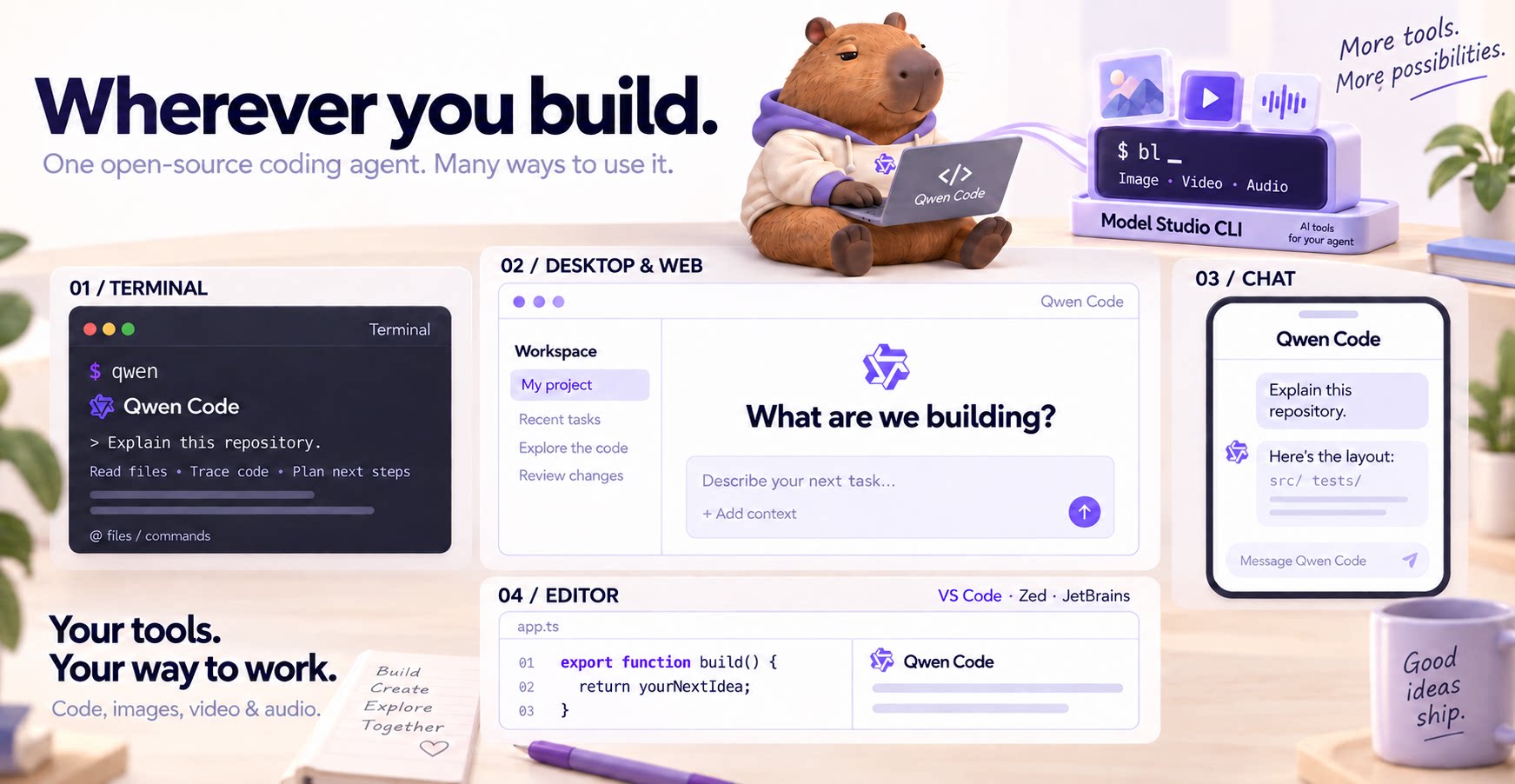
The open-source AI coding agent for your terminal, editor, desktop, browser, and chat.
中文 | Deutsch | français | 日本語 | Русский | Português (Brasil) | 한국어
Why Qwen Code?
- Agentic out of the box — Auto-Memory, Auto-Skills, SubAgents, Agent Teams, and MCP. Dynamic workflows, zero setup.
- Open-source, inside and out — The framework and the Qwen models are open-source. They evolve together. No vendor lock-in.
- Multi-protocol — Supports OpenAI, Anthropic, Gemini, and Qwen APIs. Any third-party provider or local model (Ollama / vLLM). Switch at runtime.
- Beyond the terminal — IDE plugins, Desktop app, Web UI, SDKs, and chat integrations (Telegram / DingTalk / WeChat / Feishu).
Tip
Qwen Code is actively iterating on itself — using its own agent and models to file issues, submit PRs, review code, and run tests. Powered by the community, driven by AI.
Installation
Linux / macOS:
curl -fsSL https://qwen-code-assets.oss-cn-hangzhou.aliyuncs.com/installation/install-qwen-standalone.sh | bash
Windows:
irm https://qwen-code-assets.oss-cn-hangzhou.aliyuncs.com/installation/install-qwen-standalone.ps1 | iex
Restart your terminal after installation to ensure environment variables take effect.
NPM / Homebrew
NPM (requires Node.js 22+):
npm install -g @qwen-code/qwen-code@latest
Homebrew (macOS / Linux):
brew install qwen-code
Quick Start
Open a terminal in your project and start Qwen Code:
cd /path/to/your-project
qwen
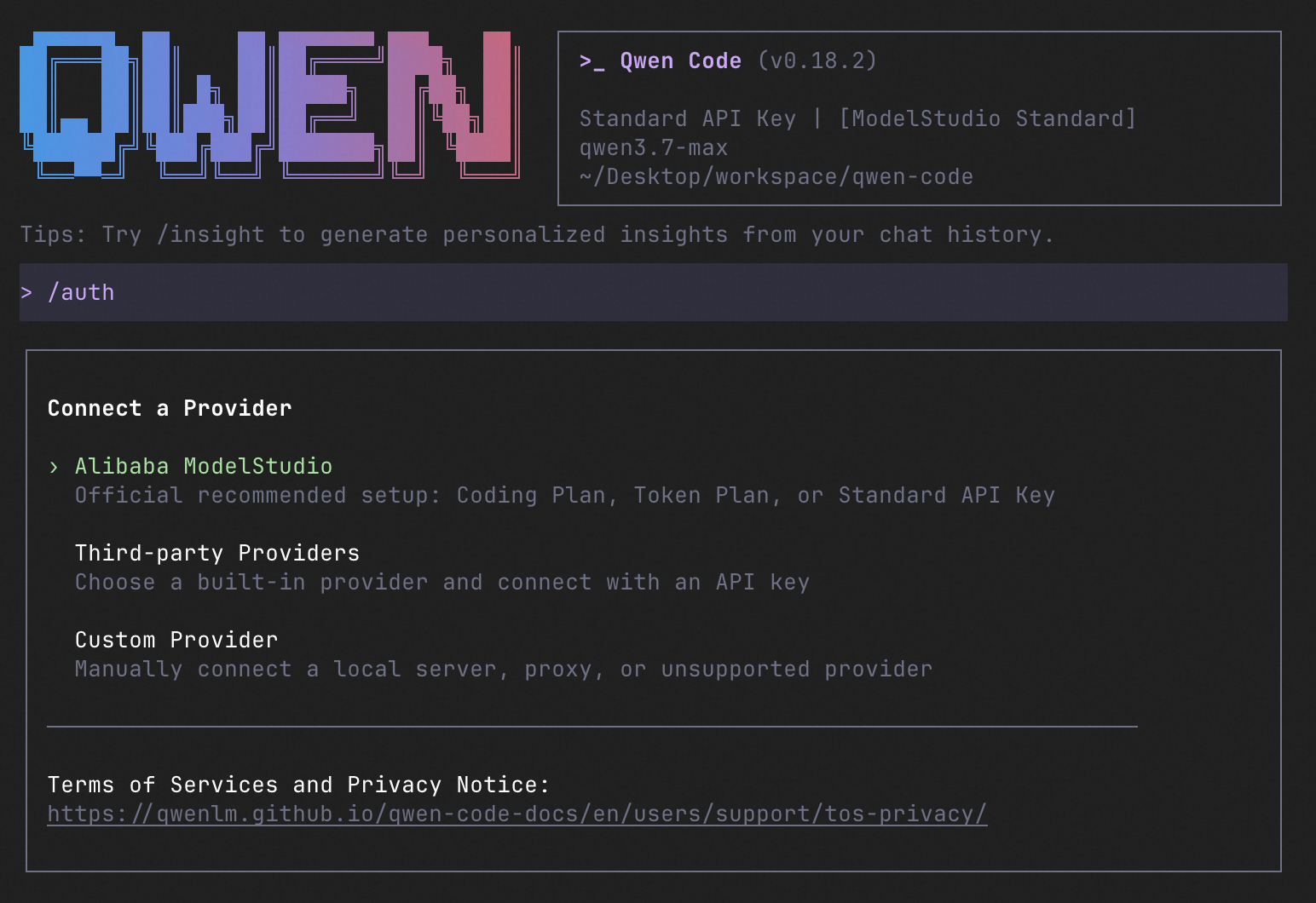
Inside the session, run /auth to configure your provider and API key. Then try:
Explain this repository and show me where to start.
See the Authentication Guide and Settings Reference for detailed setup.
See the terminal interface
How to Use Qwen Code
Choose the interface that fits your workflow:
| Interface | Get started |
|---|---|
| Terminal | Run qwen in your project — see Quick Start. |
| Desktop | Download Qwen Code Desktop for macOS, Windows, and Linux. |
| Web | Run qwen serve --open to open the Web UI in your browser. (experimental) |
| Editor | Set up VS Code, Zed, or JetBrains. |
| Chat | Connect Telegram, DingTalk, WeChat, or Feishu, then run qwen channel start. |
For automation and custom integrations:
- Headless — Run
qwen -p "..."in scripts, CI/CD, or batch jobs. - SDKs — Build with TypeScript, Python, or Java.
- Daemon — Run
qwen serveto connect clients over HTTP + SSE (ACP). (experimental) Daemon guide.
SDK example (Python)
import asyncio

from qwen_code_sdk import is_sdk_result_message, query


async def main() -> None:
    result = query(
        "Summarize the repository layout.",
        {
            "cwd": "/path/to/project",
            "path_to_qwen_executable": "qwen",
        },
    )

    async for message in result:
        if is_sdk_result_message(message):
            print(message["result"])


asyncio.run(main())
Capabilities
If you know Claude Code, you already know Qwen Code — and then some. We've put significant effort into bringing Qwen Code to feature parity with Claude Code, improving both breadth and reliability across the board.
| Feature | Qwen Code | Claude Code |
|---|---|---|
| SubAgents, Agent Teams, Dynamic Workflows | ✓ | ✓ |
| Auto-Memory, Auto-Skills, Hooks | ✓ | ✓ |
| Built-in Skills (/review, /batch, /loop, /bugfix…) | ✓ | ✓ |
| MCP, Plan Mode, LSP Integration | ✓ | ✓ |
| Auto Mode, Sandbox, Git Worktrees | ✓ | ✓ |
| Computer Use (desktop automation) | ✓ | ✓ |
| IDE Plugins (VS Code / JetBrains / Zed) | ✓ | ✓ |
| SDK | ✓ | ✓ |
| Headless Mode, Session Management | ✓ | ✓ |
| Open-source — model and framework | ✓ | — |
| Multi-protocol (OpenAI / Anthropic / Gemini / Qwen + any provider) | ✓ | — |
| Agent Arena (multi-model head-to-head on same task) | ✓ | — |
Daemon Mode — qwen serve (multi-client shared agent) |
✓ | — |
| IM Channels (Telegram / DingTalk / WeChat / Feishu) | ✓ | — |
Qwen Code Evaluation
Evaluation Configuration
| Configuration | Value |
|---|---|
| Dataset | princeton-nlp/SWE-bench_Verified, 500 cases |
| Runs | 3 trials per version, 1,500 jobs per version; 7 Qwen Code versions |
| Model | Qwen 3.7 Max |
| Sampling | temperature=1, top_p=0.95 |
| Thinking / Reasoning | interleaved_thinking=true, thinking_type=adaptive, reasoning_effort=high |
| Context / Output Limits | context_1m=true, model_context_length=1,000,000, max_tokens=64,000, model_max_tokens=65,535 |
| Harness Limits | max_iterations=500, runtime_timeout_sec=7,200, agent_timeout_multiplier=3.0 |
Scores by Qwen Code Version
| Version | Avg Score | Pass Rate | pass@3 | pass^3 |
|---|---|---|---|---|
| 0.0.14 | 77.80% | 84.6% | 84.6% | 69.2% |
| 0.1.0 | 76.73% | 84.6% | 84.6% | 68.0% |
| 0.5.0 | 76.60% | 83.0% | 83.0% | 68.4% |
| 0.10.0 | 76.47% | 84.4% | 84.4% | 67.4% |
| 0.15.0 | 77.67% | 84.6% | 84.6% | 68.6% |
| 0.19.0 | 76.40% | 85.0% | 85.0% | 65.8% |
| 0.22.0 | 77.33% | 84.4% | 84.4% | 68.0% |
Avg Score Trend

Ecosystem
-
Qwen Code Desktop — Official desktop app for macOS, Windows, and Linux
-
AionUi — A modern GUI for command-line AI tools including Qwen Code
-
Gemini CLI Desktop — A cross-platform desktop/web/mobile UI for Qwen Code
-
🦞 Qwen Code Claw — Let other agents (Claude, Codex, etc.) delegate coding tasks to Qwen Code via ACP. Paste this prompt into your agent:
Use Qwen Code as a coding agent. First, fetch and read this skill reference:
https://raw.githubusercontent.com/QwenLM/qwen-code/refs/heads/main/.qwen/skills/qwen-code-claw/SKILL.md
Then follow the instructions inside to install, authenticate, and use Qwen Code via acpx for all coding tasks.
- Aliyun Model Studio CLI — Official CLI for Aliyun's AI platform (
bailian-cli). Extends Qwen Code with image/video generation, knowledge retrieval, app orchestration, and model deployment
Privacy
See the Terms of Service and Privacy Notice, including Chrome extension and Browser Use data handling.
Contributing
Contributions are welcome! See CONTRIBUTING.md for guidelines.
Acknowledgments
This project was originally based on Google Gemini CLI v0.8.2. We gratefully acknowledge the Gemini CLI team's excellent work. Starting from Qwen Code v0.1, we stopped syncing with upstream and began independent development as a multi-protocol, multi-platform agent framework with deep integrations for Qwen models and beyond.