| .github | ||
| app | ||
| docs | ||
| fastlane | ||
| gradle | ||
| hack | ||
| tests | ||
| tmp | ||
| .gitignore | ||
| .pre-commit-config.yaml | ||
| AGENTS.md | ||
| build.gradle.kts | ||
| CLAUDE.md | ||
| DEVELOPER.md | ||
| gradle.properties | ||
| gradlew | ||
| gradlew.bat | ||
| LICENSE | ||
| Makefile | ||
| README.md | ||
| settings.gradle.kts | ||

Liseur

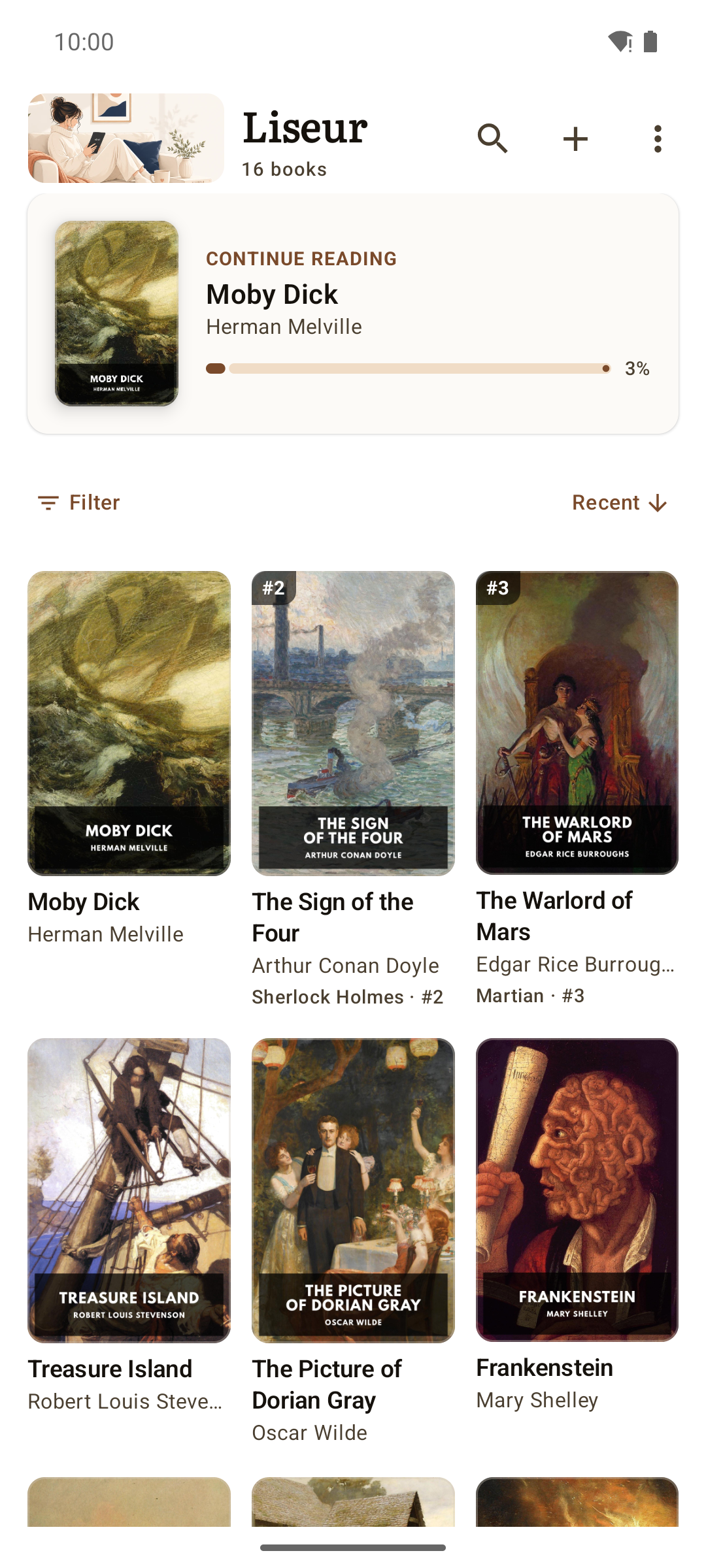
An open-source ebook reader for Android, and a client for calibre-web, Komga, liseur-sync, Grimmory and any OPDS catalog: EPUBs on your phone, in sync with your own book server.
 |
 |
 |
| The shelf, sorted by what you are currently reading. | Distraction-free page with notes and bookmarks. | Themes, open typefaces, spacing, and brightness. |
More screenshots — the notebook, search, definitions, series, reading stats, the dark theme and a tablet. Captures use Standard Ebooks editions (public domain).
About Liseur
Liseur renders EPUBs with the Readium engine, in open typefaces (Literata, Vollkorn, Atkinson Hyperlegible, Inter) or whatever the publisher shipped. Four reading themes: Light, Sepia, Dark, OLED Black. Margins, line spacing, brightness, and page-turn vs. continuous-scroll are adjustable per book or library-wide. Auto-scroll runs at a set pace and continues across chapter boundaries.
A footer shows time remaining in the chapter. Highlights, margin notes, bookmarks, and dictionary lookups are inline; book-level notes live in the notebook. Footnotes open as a card over the page rather than sending you to the back of the book.
The library is one shelf whatever the source: local folders, calibre-web, Komga, liseur-sync, Grimmory, or any OPDS catalog. Series are grouped into stacks tracking reading order, progress, and missing volumes. "Download all books" fills the shelf from a connected server in one go.
Reading position syncs across devices through calibre-web, Komga and
liseur-sync, down to the exact sentence on the last two. liseur-sync also
syncs standalone EPUBs that never came from a catalog. Grimmory keeps
your books but not your place in them, so it can be paired with a
KOReader sync (kosync) server, which is how positions travel there; any
kosync-compatible server works. So can a Custom connection, which is an
OPDS address, a kosync address, or one of the two, so a plain catalog
and a sync server that know nothing about each other still add up to a
library that follows you. What each server can and cannot do is in
docs/SERVER_CAPABILITIES.md.
No trackers, no analytics, no ads, no subscriptions. Liseur only talks to the servers and dictionary sources you configure. See the privacy policy.
Install
Related Projects
- liseur-desktop: Desktop version of Liseur
- liseur-sync: Lightweight self-hosted library and sync server. Watched folders, browse, download, positions and reading stats
- Grimmory: Self-hosted library manager. Liseur browses and downloads from it
Development
See DEVELOPER.md for build instructions and architecture notes,
and docs/SERVER_CAPABILITIES.md for what each
server exposes, what Liseur implements against it, and why the gaps remain.
What's in a name?
Liseur ([li.zœʁ], lee-ZUR) is the French word for an avid reader or book lover. It sounds dignified, like the English word leisure.
Here is a painting of Pierre-August Renoir portraying C.Monet as "Le liseur"
.jpg)
Author

Chmouel Boudjnah
- Fediverse - <@chmouel@chmouel.com>
- Twitter - <@chmouel>
- Blog - <https://blog.chmouel.com>
Licence
MIT. Bundled fonts are under the SIL Open Font License.